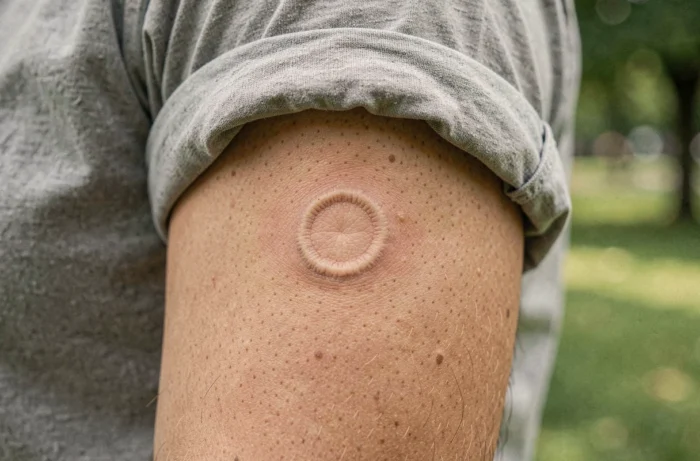
Almost everyone born before the 2010s in France has a small, slightly indented circle on the upper arm. This mark, left by the BCG vaccine, remains visible for decades after the injection. It raises questions every time it is noticed on oneself or someone else, and the answer goes beyond the simple memory of a medical act.
Intradermal BCG Injection: Why the Skin Reacts Differently
Most vaccines are injected into the muscle. The BCG, however, uses a technique called intradermal injection: the needle penetrates the superficial layers of the skin, just below the epidermis.
The injected product contains a live attenuated bacillus, derived from a bovine strain of tuberculosis. This bacillus is weakened but active enough to trigger a strong local reaction. Unlike an inactivated vaccine, it causes a small controlled infection at the injection site.
In the days that follow, a red papule appears. It sometimes evolves into a small abscess, then into a scab. The process lasts several weeks. As the skin heals, it forms fibrous tissue that remains visible: this is the scar left by the BCG vaccine. The combination of a live bacillus and a very superficial injection explains why this vaccine, and almost only this one, leaves a permanent mark on the arm.

BCG Scar and Proof of Immunization: An Overlooked Medical Use
Have you ever noticed that some doctors look at the arm before asking about vaccination history? This gesture has a specific reason.
In many countries, vaccination records are incomplete or lost. The BCG scar then serves as an indirect vaccination marker. If the mark is visible, the caregiver can reasonably assume that the person has received the vaccine.
Recent studies go further. A case-control study conducted in Ghana between 2019 and 2023 showed that the absence of a BCG scar was associated with a higher risk of leprosy. People with a visible scar had a significantly lower risk of developing the disease. This observation confirms that the mark is not merely cosmetic: it reflects a real immune response that occurred at the time of vaccination.
In practical terms, the scar has become a variable in epidemiological studies published between 2024 and 2026, particularly in communities where health records are sparse.
Immune Reaction and Immunity Induced by BCG
Why is the reaction to BCG so strong compared to other pediatric vaccines? The answer lies in what immunologists call trained immunity.
A classic vaccine teaches the immune system to recognize a specific pathogen. The BCG does this for tuberculosis, but it also activates broader defense mechanisms. The injection stimulates innate immune cells (the first line of defense, non-specific) in a lasting way.
This broad stimulation explains two things:
- The local skin reaction is more pronounced than for an inactivated vaccine because the immune system mobilizes more inflammatory cells at the injection site.
- The BCG seems to offer partial protection against other infections besides tuberculosis, which has led to research on its use against certain respiratory diseases.
- The size and appearance of the scar vary from person to person, as each immune system reacts with different intensity to the live bacillus.
A small scar does not mean poor protection. A large scar does not mean better immunity. The size of the mark reflects the local inflammatory reaction, not the level of protection acquired.

BCG Vaccination in France: A Changed Schedule
Until 2007, BCG vaccination was mandatory for all children in France. Since then, it has been recommended only for children at high risk of exposure to tuberculosis (family context, geographical area, living conditions).
This policy change explains why the scar is almost universal among adults born before 2007, but absent in many current children and adolescents. The mark on the arm has unintentionally become a generational marker.
Administration and Dose in Infants
The injection is performed on the deltoid (usually the upper left arm). In infants, the dose is adjusted according to weight and age. The intradermal technique requires precise action: an injection that is too deep reduces the vaccine’s effectiveness and alters the appearance of the scar.
When the injection is performed correctly, a small whitish elevation appears immediately. This is a sign that the product has remained properly in the dermis. This bubble disappears within a few minutes, but the inflammatory reaction that follows lasts much longer.
Why This Scar Still Intrigues Today
The BCG mark has several characteristics that make it unique in vaccination history. It is the result of a live bacillus injected into a superficial area of the skin, a combination that modern vaccines no longer use.
It persists for life, while most superficial scars fade. It also tells the story of a public health policy: its presence or absence on an arm is enough to place a person in a specific health and geographical context.
Recent research adds an additional dimension. The scar is not just a relic: it remains a usable indicator in epidemiology, used in current studies to assess actual vaccination coverage in populations where administrative data is lacking. This small circle on the arm ultimately retains a very concrete utility.