
In French grammar, a grammatical class refers to the category to which a word belongs based on its morphological and syntactic properties. In the 6th grade curriculum, this concept forms the foundation for sentence analysis, agreement, and writing. Paper-based exercises remain a concrete lever to anchor these distinctions, as they require the student to manipulate each word outside of oral flow.
Variable and invariable words: the distinction that structures the entire 6th grade curriculum
Before classifying a word as a noun, adjective, or adverb, a 6th grade student must integrate a preliminary criterion: a word is variable if it changes form according to the context. The noun takes the plural form, the verb is conjugated, and the adjective agrees in gender and number. In contrast, an adverb, preposition, or conjunction always retains the same form.
This binary distinction (variable or invariable) simplifies the initial sorting. On a printed sheet, an effective exercise consists of presenting a list of words extracted from a short text and asking for two classification columns. A student who hesitates on “rapidly” checks: can it be put in the feminine or plural? No, therefore it is invariable.
Working on 6th grade grammatical class exercises to print allows for repeating this verification gesture until it becomes automatic, without relying on a screen or an internet connection.
The French program for cycle 3, published in the Official Bulletin No. 16 on April 17, 2025, emphasizes that grammar and spelling should permeate reading and writing activities rather than remain an isolated block. In other words, classifying a word only makes sense if the student reinvests this classification in their own writing.
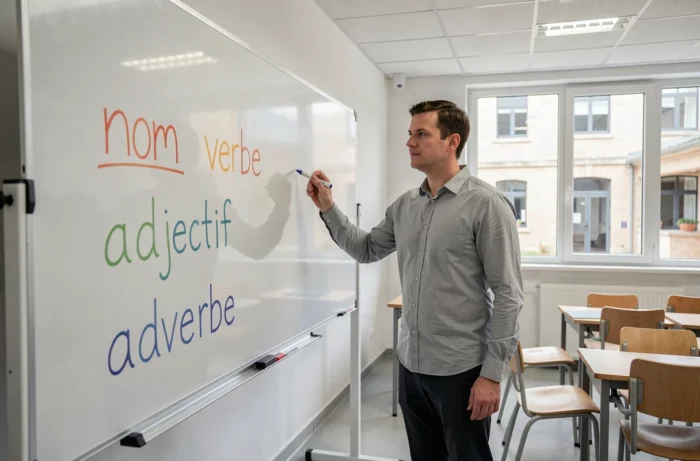
The five variable grammatical classes to master on printed sheets
The 6th grade program focuses on five categories of variable words: noun, determiner, adjective, pronoun, and verb. Each follows specific agreement rules, and this is where the most frequent errors appear in students’ work.
Noun and determiner: a duo to identify together
A noun is rarely alone. It is almost always preceded by a determiner (article, possessive, demonstrative). On a sheet, a useful exercise asks students to circle each “determiner + noun” group in a paragraph. This visual identification trains the eye even before the student names the grammatical class.
Beware of the classic trap: some determiners look like pronouns. “The” in “the cat sleeps” is a determiner. “The” in “I see him” is a pronoun. Only the context of the sentence allows for a decision, and this is precisely what the paper exercise forces students to analyze word by word.
Adjective and pronoun: two sources of errors in writing
The qualifying adjective agrees with the noun it characterizes. Correctly identifying it avoids the most common agreement errors in 6th grade. On a sheet, a transformation exercise (changing from masculine singular to feminine plural) makes the rule concrete.
The pronoun replaces a noun or noun group. Pronoun repetitions are also identified in official texts as a major point of vigilance in 6th grade. A rewriting exercise, where the student must replace repetitions with appropriate pronouns, develops both grammar and writing quality.
The verb: the pivot of the sentence
Recognizing the conjugated verb in a sentence is the most sought-after grammatical gesture in middle school. On a sheet, the identification exercise involves a simple test: change the tense of the sentence. The word that changes form is the verb. This mechanical reflex, repeated on paper, eventually becomes instantaneous.
Adverb, preposition, conjunction: the invariable classes in grammar exercises
Invariable words pose a different problem. Since they never change form, the student cannot rely on agreement to identify them. They must understand their syntactic role.
- The adverb modifies a verb, an adjective, or another adverb. “Very,” “slowly,” “not…any” fall into this category. A relevant exercise consists of removing the adverb from a sentence to check that the sentence remains grammatically correct, even if the meaning changes.
- The preposition (“to,” “of,” “for,” “with”) introduces a complement. On a sheet, asking the student to underline the preposition and then identify the group it introduces reinforces understanding of sentence construction.
- The coordinating conjunction (“but,” “or,” “and,” “therefore,” “now,” “nor,” “because”) connects two elements of the same function. The classic exercise of inserting the correct conjunction into a fill-in-the-blank sentence remains effective because it forces students to think about the logical link between the propositions.
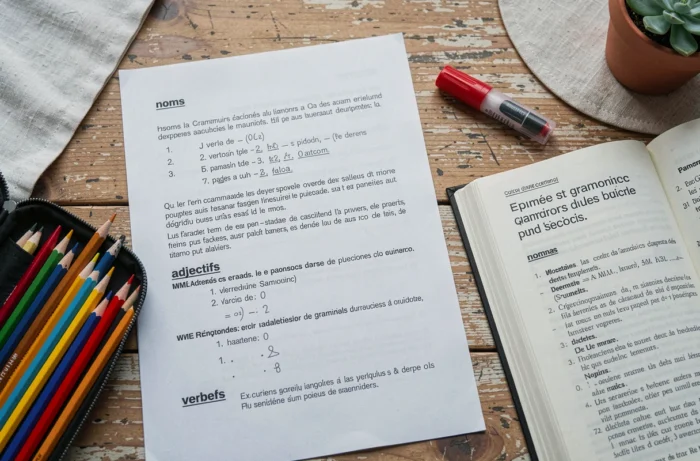
Building a progression on sheets: from isolated identification to complete sentence analysis
A common mistake is to distribute sheets focusing on only one grammatical class at a time, without ever mixing. The student succeeds in the exercise on adjectives because they know that the sheet is about adjectives, not because they can recognize them in any text.
The progression benefits from following three distinct levels. The first level isolates each class (one sheet per category). The second level mixes two or three classes in the same exercise. The third level presents a complete text where the student must analyze the grammatical class of underlined words without prior indication.
This third level corresponds to what the national assessments for 6th grade actually test. The student finds themselves facing a text, without any clue about the expected category. Only repetition on paper sheets, with immediate correction, allows for achieving this analytical autonomy.
The choice of verb tenses constitutes another point of vigilance highlighted by official texts. A sheet that simultaneously asks to identify the grammatical class and the tense of the conjugated verb better prepares students for the real test than a sheet limited to a single objective.
Printed sheets retain a concrete advantage over digital exercises: the student can annotate, circle, and connect with arrows. This graphic work on language, pen in hand, mobilizes a gestural memory that the screen does not engage in the same way.