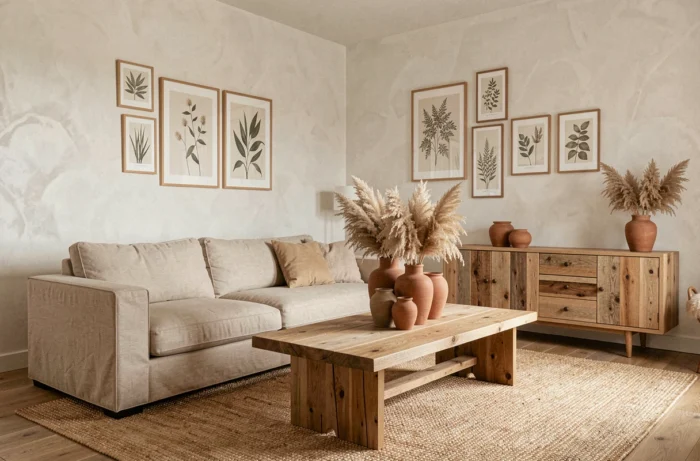
Between regulatory labels, materials to monitor, and sometimes misleading marketing claims, choosing a decoration that is both trendy and eco-friendly requires comparing concrete criteria. What benchmarks help distinguish a truly healthy product from a mere commercial argument in a design home?
Labels and certifications: what regulations really require for interior decoration products
The first reflex before buying a floor covering, paint, or wall panel is to turn over the packaging. Since September 1, 2013, the “indoor air emissions” label is mandatory for construction and decoration products intended for indoor use. It classifies each product from A+ (very low emissions) to C (high emissions).
However, this label does not apply to furniture. A sofa, coffee table, or particle board shelf does not display any emissions classification, even though these pieces of furniture can release volatile organic compounds for months after purchase.
| Product Category | Mandatory Indoor Air Label | Mandatory TRIMAN Logo |
|---|---|---|
| Paints, varnishes, adhesives | Yes (classification A+ to C) | Yes |
| Floor coverings | Yes (classification A+ to C) | Yes |
| Furniture (tables, sofas, shelves) | No | Yes (since December 15, 2022) |
| Upholstery textiles | No | Yes (extension by the end of 2024) |
For furniture, the benchmark becomes the TRIMAN logo, which indicates a sorting and recycling system. It has been mandatory on furniture products sold in France since December 15, 2022, and will extend to other product families by the end of 2024. This logo does not guarantee the ecological quality of the furniture, but it certifies that the manufacturer contributes to a regulated end-of-life system.
Many topics related to sustainable development and design are detailed in the home section of Butterfly Mag, which regularly addresses material choices and decoration trends.
Green claims on furniture and decorative objects: what the AGEC law prohibits

A decorative object bearing the label “environmentally friendly” or “biodegradable” without proof is now illegal. Since the AGEC law, vague ecological claims are prohibited on a product or its packaging. The term “carbon neutral” is subject to strict justification conditions.
In practical terms, this means that a manufacturer of scented candles or wooden frames can no longer make a generic green claim without verifiable data. The text targets vague formulations like “eco-friendly,” “natural,” or “green” that do not refer to any measurable standard.
- The terms “biodegradable” and “environmentally friendly” can no longer appear alone on the packaging of decoration products sold in France.
- Any claim of carbon neutrality must be based on a detailed carbon footprint and an emissions reduction plan accessible to the consumer.
- Recognized labels (NF Environment, European Ecolabel, PEFC, FSC) remain the only reliable benchmarks for assessing a verifiable ecological commitment on furniture or decorative objects.
This regulatory evolution changes the game for buyers: a product without a recognized label claiming to be “ecological” should be approached with caution.
Indoor air quality: the design criterion that 2026 trends highlight
Indoor air quality is re-emerging as a choice criterion in 2026 decoration trends. This is no coincidence: bio-based paints, lime coatings, and solvent-free finishes are gaining ground in manufacturers’ ranges.
Choosing low-emission materials is not limited to walls. The adhesives used to secure flooring, the treatment applied to wooden furniture, or the composition of an upholstery fabric directly influence the concentration of pollutants in a closed room.
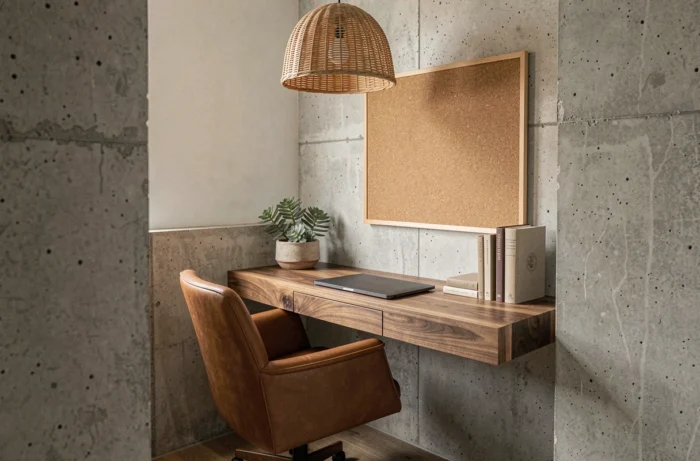
The A+ classification of the indoor air label remains the target threshold for any product that falls under it. For furniture, checking for certifications like PEFC or FSC on wood ensures that the raw material comes from sustainably managed forests, a more reliable indicator than a simple mention of “natural wood.”
Paints are often an underestimated factor. A paint rated A+ emits significantly fewer volatile organic compounds than a paint rated B, even after complete drying. This difference can be measured over several weeks in a poorly ventilated room.
Sustainable materials and design: balancing between wood, recycled metal, and certified textiles
A trendy and eco-friendly interior relies on concrete trade-offs between materials. FSC or PEFC certified wood remains the most documented choice for sustainable furniture. In contrast, a cheap particle board piece of furniture without certification can emit formaldehyde for months.
Recycled metal (steel, aluminum) offers an interesting alternative for lighting fixtures and table bases. Its lifespan is long, and its recyclability at the end of life is almost total. Favoring furniture designed to be disassembled and recycled rather than glued and stapled extends their usage cycle.
- PEFC or FSC certified wood: traceability of the raw material, low emissions if solvent-free finish.
- Recycled metal: high mechanical durability, recyclable in a closed loop, suitable for industrial and contemporary styles.
- Certified textiles (Oeko-Tex, GOTS): guarantee of the absence of harmful substances upon contact, relevant for cushions, curtains, and covers.
- Second-hand and upcycling: nearly zero carbon impact at purchase, compatible with all decorative styles.
The choice of material conditions both the style and the health impact of a room. A living room combining a GOTS fabric sofa, an FSC oak table, and a recycled steel light fixture checks the boxes of contemporary design without compromising on ecological commitment.
French regulations are gradually pushing manufacturers and distributors towards greater transparency. For a buyer, the most effective strategy remains to cross-reference the indoor air label (when it exists), material labels, and the TRIMAN logo before finalizing a decoration purchase. These three benchmarks are sufficient to rule out the majority of products whose green arguments are not based on anything measurable.