Blue light and cognitive stimulation from screens are not enough to explain why a gamer sleeps poorly. A synthesis published in 2024 in Sleep Review, covering 26 studies, shows that the impact on sleep depends more on the timing of the session and the type of game than on the number of hours spent gaming. Understanding these mechanisms allows for action on the right levers without giving up one’s passion.
Bedtime Usage and Falling Asleep: A Distinction Gamers Overlook
Most advice pits “screen” against “sleep” as if the context of use were irrelevant. A longitudinal study published in 2024 in JAMA Pediatrics, conducted on 79 young people aged 11 to 14, provides a crucial nuance.
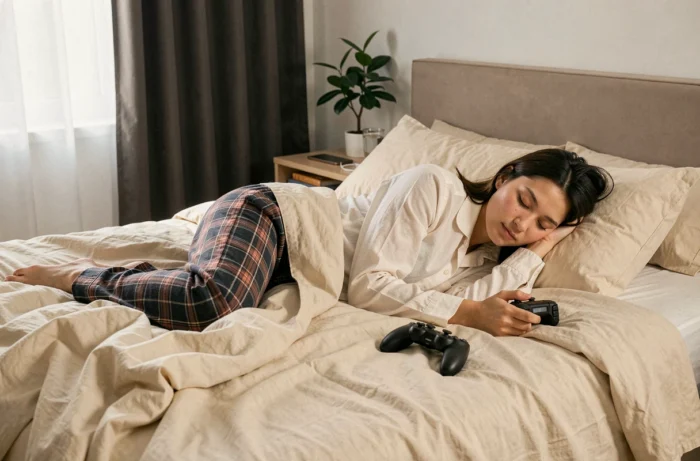
The researchers found no clear association between screen use in the two hours before bedtime and most sleep indicators. However, using screens once in bed delays falling asleep and shortens total rest duration, especially when it involves interactive activities like video gaming or multitasking.
For a gamer, the practical consequence is clear: playing on the couch at 10 PM does not have the same effect as starting a game on a portable or a Switch once in bed. The bed should remain a space associated with sleep, not a last ranking game. Resources dedicated to this topic are available at insomniedugeek.fr, which details the mechanisms specific to sleep disorders in regular gamers.
Type of Video Game and Cognitive Excitement Before Night
Not all games provoke the same level of activation. A competitive online match (FPS, battle royale, MOBA) triggers dopamine spikes and keeps the nervous system alert. The body remains in “fight or flight” mode long after the game ends.
The synthesis from Sleep Review confirms that highly stimulating games just before bedtime delay falling asleep, while a calmer practice finished earlier in the evening is not systematically associated with sleep degradation.
Adapting Evening Sessions to Stimulation Levels
Reserve competitive matches or demanding raids for early evening, then switch to a narrative game, a city builder, or a puzzle game in the last hour before stopping: this sequencing gradually reduces cognitive activation.
The goal is not to eliminate nighttime gaming, but to create a decrease in intensity throughout the evening. Transitioning from Valorant to Stardew Valley acts as a de-escalation ramp for the brain.
Sleep Schedule Regularity Among Gamers
Many gamers compensate for a short night with a lie-in on the weekend. This strategy is counterproductive. An analysis published in 2024 in Sleep, based on over 10 million hours of accelerometer data from nearly 61,000 participants, establishes that the regularity of sleep schedules matters as much as the total duration of sleep.
Specifically, going to bed at midnight every night produces better quality sleep than going to bed at 11 PM on weekdays and at 3 AM on weekends, even if the weekly average hours are the same.
Setting a Stopping Time Rather Than a Game Quota
Saying “I’ll stop after two games” doesn’t work because the duration of a game varies. Setting a fixed stopping time (for example, 11:30 PM, seven days a week) anchors a consistent signal for the biological clock. An alarm or notification on the phone, set 15 minutes before, allows time to finish properly.
- Set a consistent bedtime on weekdays and weekends, with a maximum tolerance of 30 minutes.
- Schedule a “pre-stop” alarm to avoid starting an extra game out of habit.
- Avoid compensatory lie-ins: waking up at the same time stabilizes the circadian rhythm.
Lighting Environment and Blue Light Filtering for Gamers
The blue light emitted by LED screens affects the retinal photoreceptors involved in regulating the sleep-wake rhythm. Late exposure to this wavelength inhibits melatonin secretion and pushes back the sleep window.
For a gamer who cannot turn off their screen an hour before bedtime, several strategies reduce exposure without degrading the gaming experience.
- Activate the night mode or blue light filter built into the operating system (Windows, macOS, Android) starting at 8 PM.
- Reduce monitor brightness to a comfortable but low level in the last hour of gaming.
- Illuminate the room with a warm light lamp (amber) rather than playing in complete darkness, which forces the pupil to open and increases exposure.
- Wear amber-filter glasses if the software filter alters colors too much in a competitive game.
These adjustments do not completely eliminate the effect of blue light, but they significantly mitigate its impact on melatonin.
Sleep and Performance in Video Gaming: The Virtuous Circle
A sleep-deprived gamer sees their reaction times, decision-making, and working memory deteriorate. The American Academy of Sleep Medicine recommends 8 to 10 hours of sleep per night for adolescents, a demographic heavily represented in competitive gaming and esports.
Sleeping better directly improves gaming performance, making the trade-off less painful than it seems. The discipline of sleep is not a sacrifice imposed by health against the pleasure of gaming: it is a lever for progress just like mechanical training or reviewing replays.
The most underestimated point remains regularity. A gamer who protects their schedule, adjusts the intensity of their evening sessions, and does not play once in bed already covers most modifiable factors without giving up a single minute of gaming.