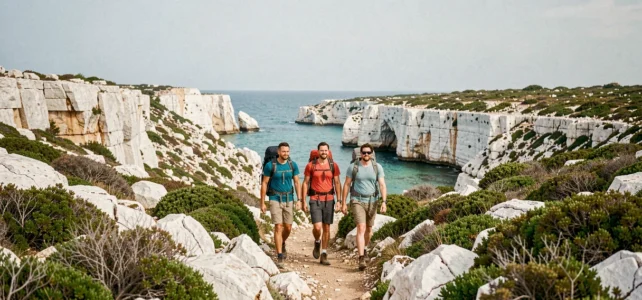
The calanque of la Vesse is not the kind of place that appears on Marseille’s postcards. Located in the municipality of Rove, nestled between the railway viaduct of the Côte Bleue and a few colorful cabins, it mainly attracts those looking for quick access to the sea without the crowds of nearby spots.
Its parking lot just a few meters from the water makes it a favored starting point for diving, snorkeling, or simply launching a kayak.
Summer Regulations on the Rove Massif: the Green and Red System
Before planning anything, there’s a reflex to adopt: check the color of the day. For several summers, access to the forested massifs of Bouches-du-Rhône, including that of Rove which encompasses la Vesse, is subject to a daily decision made the day before around 5-6 PM.
The principle is simple. Green means access allowed, red means access prohibited, even if you arrive by sea. The official map or the “Mes Calanques” app provides information massif by massif.
Planning to hike the coastal path towards Niolon or Figuerolles? On a red day, that’s a no. Any presence on land in the affected massif is prohibited. However, navigation and swimming in the sea remain possible at a distance from the coast, without landing or mooring on the rocks or beach.
To properly organize the access to the calanque of la Vesse, you must integrate this variable from the evening before, especially between June and September when the fire risk regularly increases.
Diving and Snorkeling at la Vesse: Why This Site Attracts Practitioners
Most visitors come to la Vesse for what happens underwater, not above. The parking lot located just a few meters from the edge allows for unloading bottles and equipment without straining your back on a rocky path.
Conditions for Entering the Water
Entry into the water is from the rocks or the small cove accessible after the islets. No sandy beach, no ladder. You need to be comfortable entering the water on pebbles and limestone rocks. Water shoes can drastically improve comfort.
No lifeguard station is set up at la Vesse, even in the height of summer. Along the entire Marseille coastline, only two beaches have lifeguards (Sormiou and Saint-Estève at Frioul). This means you must assess the swell and current conditions yourself, and never dive alone.
What to Observe Underwater
The rocky bottoms of the Côte Bleue host a biodiversity typically Mediterranean. The underwater relief, with its limestone cliffs extending the terrestrial cliffs, creates shaded areas where species concentrate. Underwater hunting enthusiasts frequent the site for this reason.
For snorkeling, the area around the islets offers accessible depth and generally good visibility except on days of strong mistral winds.
Coastal Path to Niolon and Figuerolles: Two Directions, Two Atmospheres
La Vesse is not a destination in itself for hiking, but a connection point between two very different coastal routes.
- Towards Niolon (east): the path at the end of the parking lot leads to the calanque of Niolon in just a few minutes of coastal walking. The elevation gain is low, and the path is passable in sneakers. Niolon has a small port, restaurants, and a diving center, making it a good option to extend the outing.
- Towards Figuerolles (west): by taking the customs officers’ path and then the coastal path marked in blue, you reach this wilder calanque. The terrain is more rugged, with passages over exposed rock. Allow more time and bring water.
- Loop through the Nerthe Massif: for experienced hikers, the paths that ascend into the massif offer stunning views over the calanques. Be careful, these paths are the first to be closed on red days.
Parking and Hours: What Guides Don’t Always Detail
The parking lot at la Vesse is both the main asset of the site and its limitation. Its capacity remains modest. In summer, a sunny weekend is enough to fill it by late morning.
Arriving before 9 AM in summer almost always guarantees a spot. After 10:30 AM, you often have to resort to parking in the village of Rove and walk down, which adds time and elevation gain on the return.
The train alternative is worth mentioning. The Côte Bleue railway line, the very one whose viaduct overlooks the calanque, serves the Niolon station. From there, the coastal path leads back to la Vesse in just a few minutes. This option eliminates parking stress and offers a scenic journey from Marseille.
Picnic and Swimming: Adapting Your Day to the Terrain
La Vesse is not set up for beach comfort. No shower, no public trash can, no naturally shaded area by the water. The cabins lining the calanque are private properties.
In practical terms, a good outing to la Vesse should be prepared like an outing in a semi-wild environment:
- Sufficient water (no drinking water source on site)
- Enhanced sun protection, as the reflection on the white limestone amplifies exposure
- Trash bag to take all your waste back, as no waste collection is provided on site
- Mask and snorkel if swimming is planned, the rocky bottoms near the shore justify the equipment
Swimming itself is done from the rocks. The water is generally clear, but the swell can make getting out of the water tricky on windy days from the west. With children, it’s better to favor calm days and supervise constantly, given the complete absence of safety measures.
The calanque of la Vesse does not seek to attract visitors with infrastructure. It is precisely this simplicity that filters visitors and preserves the atmosphere of the place. The viaduct above, the cabins below, the Mediterranean in front: the setting is self-sufficient, as long as you have checked the color of the day and filled your water bottle.