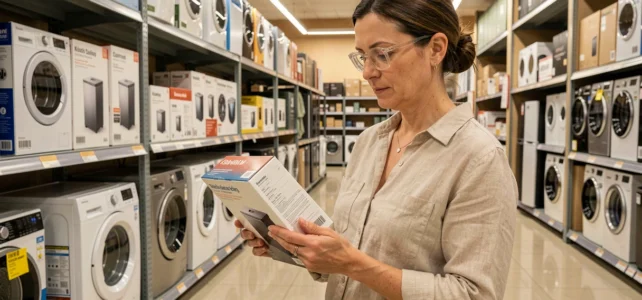
Since January 2025, France has implemented a new durability index for certain household appliances. This regulatory change alters the framework for anyone looking to equip or renew their home appliances on a daily basis. Labels are evolving, comparison criteria are changing, and the usual benchmarks are no longer sufficient for making an informed choice.
Durability index and energy label: what has changed for household appliances
The reparability index, in effect since 2021, has been replaced by a durability index for televisions since January 8, 2025, and for washing machines since April 8, 2025. The difference is not cosmetic: the rating now incorporates the reliability and robustness of the product, not just its ability to be repaired.
In practical terms, two washing machines displaying the same reparability score could previously have very different lifespans. The new index reduces this blind spot by assessing the mechanical resistance and longevity of the components. For a kitchen or bathroom purchase, this information carries significant weight.
Another shift to be aware of: tumble dryers have changed their energy scale as of July 1, 2025. The old classes A+, A++, and A+++ have disappeared in favor of a scale from A to G. A device rated A+++ yesterday may now be classified as C or D on the new scale. Comparing a model purchased two years ago with a current model without considering this recalibration leads to false conclusions.
Each appliance available on Direct Maison can thus be reassessed according to these new criteria before purchase.
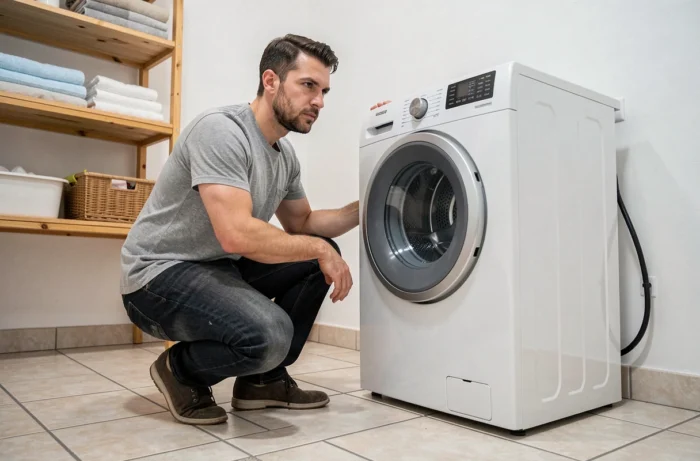
Selection criteria for kitchen and maintenance equipment
Competing guides often list appliances piece by piece. This catalog approach masks a problem: not all criteria carry the same weight depending on actual usage. A refrigerator runs continuously, while an oven operates only a few hours a week. The annual consumption of the former far exceeds that of the latter, and the budget hierarchy should take this into account.
Reliability and maintenance cost over five years
The purchase price represents only part of the total cost. The European directive on the right to repair, transposed in France, requires manufacturers to make spare parts available for a minimum period after the product is placed on the market. However, the availability of a part does not guarantee a reasonable price.
Before choosing a cleaning or kitchen appliance, checking the average price of wear parts (filter, seal, heating element) provides a more realistic picture of the five-year budget. Field feedback varies on this point: some brands list available parts but at prices that make repair economically unfeasible compared to replacement.
Actual consumption and energy label
The energy label remains the most reliable reference, provided you read the correct scale. For products that have not yet transitioned to the new A-G classification, the old classes still apply. Checking the market launch date of the appliance allows you to know which scale applies.
- For washing machines and tumble dryers: prioritize models displaying the new A-G scale, which is more discriminating than the old one
- For refrigerators and freezers: the new scale has been in place for several years, so comparisons are direct
- For small kitchen appliances (mixers, kettles): no mandatory energy label, making consumption comparison more opaque
Storage and everyday tools: what the label doesn’t say
While household appliances capture attention, a well-equipped home also relies on elements that no one labels: storage solutions, common DIY tools, bathroom accessories. For these products, no durability index exists. The choice then relies on empirical criteria.
Materials determine longevity far more than the brand. A low-quality particle board storage unit will deform under load within months. An equivalent made of sufficiently dense MDF or solid wood will last for years, often at a moderate additional cost at purchase.
For cleaning and maintenance tools (brooms, mops, cleaning accessories), the most underestimated criterion remains the compatibility of consumables. A high-performing steam mop whose replacement pads are unavailable or overpriced becomes a losing purchase in the medium term.

Right to repair: how it influences equipment choice
The recently adopted European directive on the right to repair changes the game for French consumers. It requires manufacturers to offer repairs for certain devices even after the end of the legal warranty. The covered categories include washing machines, vacuum cleaners, and smartphones, among others.
This obligation does not cover all household equipment. Furniture, lighting, and small tools are excluded. Regulated repair only concerns devices with a reparability or durability index.
- Before purchasing, check if the product falls within the scope of the right to repair
- Consult the durability score when it exists, distinguishing the overall score from the sub-criteria (reliability, availability of parts, price of parts)
- Prefer manufacturers who publish their repair manuals for free access, a sign of a concrete commitment beyond the legal obligation
The available data does not yet allow for measuring the real impact of this directive on repair prices in France. Initial feedback will only be significant after several cycles of breakdowns on the affected devices.
The choice of a household appliance now hinges on three levels: the purchase price, the operating cost visible on the energy label, and the maintenance cost that only the durability score and the manufacturer’s pricing policy can help anticipate. Ignoring any of these three levels means accepting to pay the difference later.