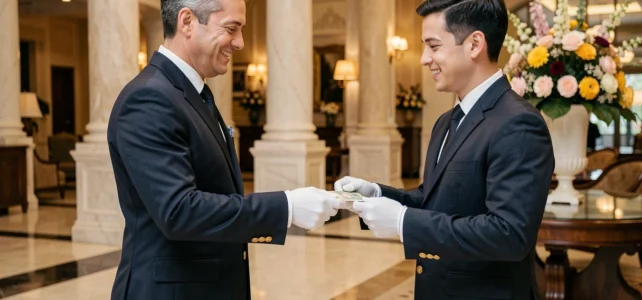
The tip in a 5-star hotel does not follow an official scale. In France, service is included in the room price, which means that any gratuity remains a voluntary gesture. The amount varies depending on the employee’s position, the type of service provided, and the country where the establishment is located.
Tax exemption for tips in France: what the customer really finances
Leaving a few euros on the nightstand or in the hand of a bellhop does not have the same effect depending on the current tax framework. Since the finance law for 2022, tips given to employees who interact with customers benefit from a tax exemption on income and social contributions. This measure has been extended until December 31, 2028, by the finance law for 2026 (law no. 2026-103 of February 19, 2026, art. 5).
The condition: the employee’s basic salary must not exceed 1.6 times the monthly minimum wage. In a 5-star hotel, this limit excludes management positions but covers most housekeeping staff, bellhops, and receptionists. Thus, the tip arrives net in the pocket of the concerned employee, without deductions. It is a direct increase in purchasing power.
Knowing that the amount reaches its recipient in full changes the perception of the gesture. Every euro given to a housekeeper whose salary is below this threshold represents a net euro, which is a rarely mentioned argument in the usual 5-star hotel tipping guidelines.
Tip amount by position: housekeeper, bellhop, concierge
Not all members of a high-end hotel staff provide the same service, and the expected amount reflects this difference. Applying a single amount to each interaction ignores the reality of the work done.
Housekeeping and cleaning staff
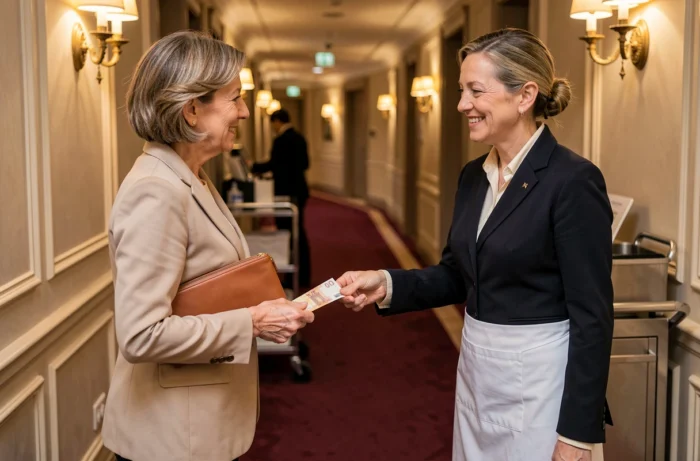
The housekeeper is the position for which tipping is most common. In France, the practice is to leave the amount each day, not just at the end of the stay. The reason: teams rotate, and the person cleaning the room on Monday is not necessarily the one on Friday. A daily amount ensures that each agent receives their share.
International guides converge on one point: the tip for cleaning in a premium establishment is in the upper range of local customs. For France, where gratuities remain modest compared to American standards, a few euros per night are enough to express appreciation for attentive service.
Bellhop and valet
The bellhop assists upon arrival and departure. The tip is given directly at the time of service. The amount depends on the volume of luggage: a trunk and three bags require more effort than a simple carry-on. The valet, when available, follows the same logic of immediate gratuity.
Concierge: a special case
The concierge of a 5-star hotel handles complex requests (reservations at fully booked restaurants, show tickets, organizing transfers). The tip for the concierge is justified by the difficulty of the request, not by the number of interactions. Securing a table at a popular restaurant on a Saturday night deserves more than just a simple direction.
- Housekeeper: daily tip, left on the nightstand or in an envelope, so that each rotating agent benefits.
- Bellhop and valet: tip given directly at the time of service, proportional to the physical effort.
- Concierge: tip at the end of the stay or after a specific request successfully resolved.
- Room service: check if service charges are already included on the bill before adding a gratuity.
Service charges included or not: the trap to check before giving
Some 5-star hotels add a “service charge” line on the final bill. This supplement, which represents a percentage of the total stay amount, is supposed to compensate the staff. The problem: its distribution among employees varies by establishment and is not always transparent.
In France, the mention “service included” on displayed prices means that the rate already incorporates staff compensation. An additional tip is welcome but not mandatory. In other countries, the service line added to the bill does not replace the tip expected by each staff member.
The reflex to adopt: consult the detailed bill or ask directly at the reception if a service charge has been applied. This verification avoids giving twice or not giving at all, thinking that the staff has already been compensated through the charges.

Tips in 5-star hotels abroad: differences by country
The amount and form of tipping change radically from one country to another. In the United States, gratuity is an integral part of hotel staff income. Not tipping is perceived as a social faux pas. In East Asia (Japan, South Korea), the gesture can conversely be felt as an offense, as service is considered a professional duty.
Cashless payment is also changing habits. Digital tipping platforms are developing in hotels, with QR codes placed in rooms. This system allows the customer to tip without cash and enables the hotel to track the distribution among employees.
- United States: hotel tipping is an expected standard at every interaction with staff.
- France and Western Europe: service is included, gratuity remains voluntary and moderate.
- Japan: tipping is generally refused or even viewed negatively.
- Middle East: practices vary by country, often encouraged in luxury hotels.
Before traveling, identifying the customs of the destination country helps avoid a misstep. Tipping in a 5-star hotel in Dubai does not follow the same codes as in Tokyo or Paris. The only constant, regardless of the country: giving the amount directly to the person concerned remains the most reliable method for ensuring the gesture reaches its intended recipient.