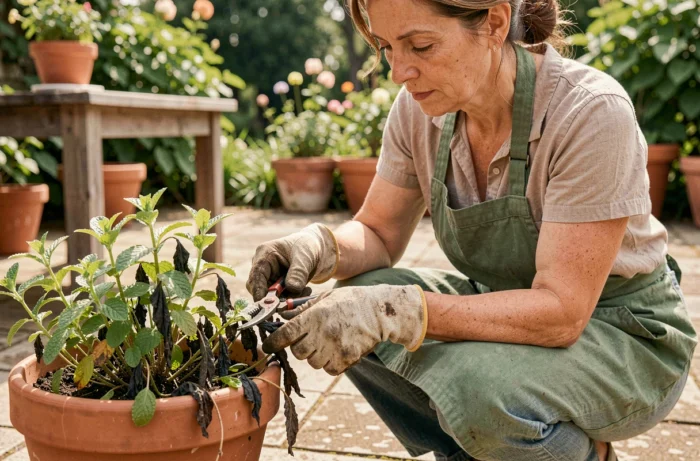
Mint leaves turning black is a warning sign, not a death sentence. Before tearing everything out, it’s essential to understand what causes this blackening. Depending on the appearance of the spots and their location on the plant, the cause varies radically, and so does the treatment.
Drainage of the substrate and root asphyxiation: the problem to address first
Most guides focus on fungal diseases. However, when growing mint in pots, the first instinct should be to turn the container over and check the drainage holes.
An overly compact substrate retains water around the roots. These roots lack oxygen, rot, and the leaves blacken from the bottom of the plant. This is not a fungus; it’s a slow drowning.
Have you ever noticed that the soil stays soaked for more than two days after watering? This is a sign that your mix is too heavy. The solution is to lighten the soil with perlite or coarse sand to recreate porosity. Also, check that the holes at the bottom of the pot are not blocked by roots or debris.
In open ground, the problem is less frequent, but a poorly drained clay area produces the same effect. If water stagnates around the base after rain, elevate the clump or move it to a more draining spot. When dealing with blackened mint leaves, this substrate check should always precede any treatment.
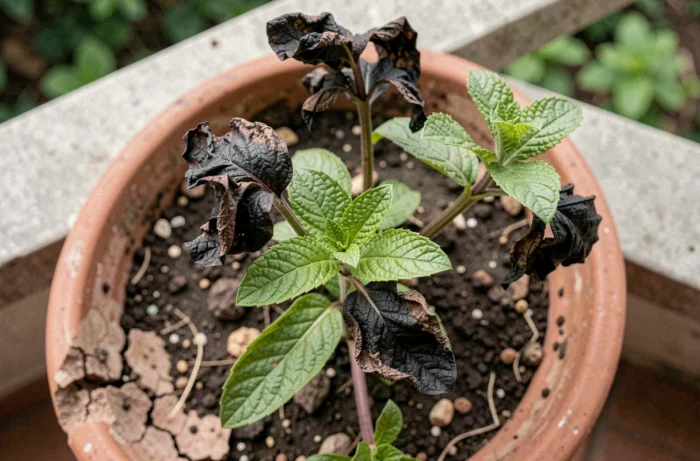
Black spots on mint: distinguishing rust, sooty mold, and sunburn
Once drainage issues are ruled out, three main causes remain. They can be recognized with the naked eye if you know what to look for.
Fungal rust on mint leaves
Rust (Puccinia menthae) produces orange or brown-black pustules on the underside of the leaves. On the top, yellow-orange spots appear that eventually turn black. This fungus loves humidity and mild temperatures.
Remove each affected leaf by hand. Do not compost them: a home compost does not get hot enough to destroy the spores. Simply throw them in the trash.
Sooty mold related to aphids
Black spots on the top of the leaves, accompanied by a sticky texture, indicate sooty mold. This fungus does not directly parasitize mint. It feeds on the honeydew that aphids deposit on the foliage.
Here, treating the fungus alone is pointless. You must first eliminate the aphids. A strong jet of water is often sufficient. For stubborn infestations, a neem oil spray works, provided you treat early in the morning or in the evening to prevent the oil from burning the leaves in the sun.
Sunburn or water stress
When the edges of the leaves blacken and become dry, without any powder or sticky texture, it’s sunburn. Too much direct sunlight in summer or a lack of water causes this. Mint prefers partial shade, especially in the south of France.
Pruning and disinfecting: the action that prevents spread
Whatever the cause, pruning remains the first intervention. Cut the affected stems below the blackened area, down to a healthy node. Mint regrows quickly from the underground stolons.
A detail often overlooked makes the difference between effective pruning and pruning that spreads the problem: disinfect your pruners between each cut. A cloth soaked in isopropyl alcohol on the blades is sufficient. Without this precaution, you transfer spores from a sick stem to a healthy one.
After pruning, here are the important actions:
- Collect all fallen leaves around the base, as they harbor spores that will reinfect the plant at the next watering
- Space out waterings to allow the substrate to dry on the surface between waterings, which slows fungal development
- Air out the remaining foliage by removing the densest stems in the center of the clump, so that air circulates better
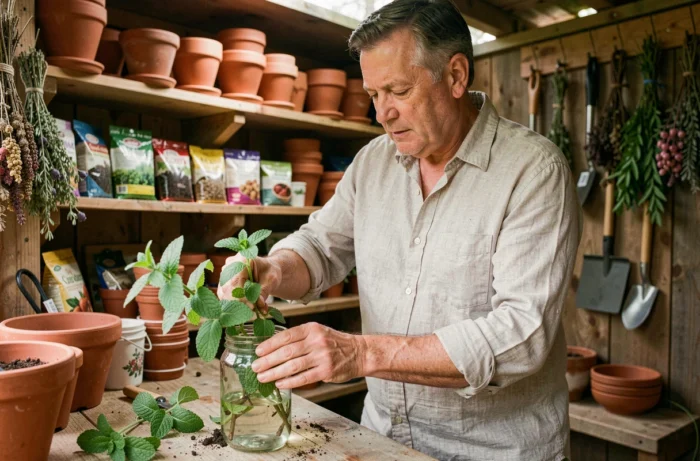
Potted mint or in the ground: adapting care to the container
Potted mint and mint in the ground do not react the same way. In pots, the volume of soil is limited. The substrate quickly becomes depleted, compacts, and the roots circle around. These conditions favor root asphyxiation and diseases.
Repot your mint every spring with fresh, well-draining mix. Choose a pot with at least three holes, slightly larger than the previous one. Place a layer of clay balls or gravel at the bottom.
In open ground, mint is more self-sufficient. The main risk is excessive damp shade, which promotes rust. If your plant is located under a dense shrub, severely cut it back at the end of the season and clear the surrounding vegetation to improve air circulation.
Another pitfall in open ground: mint invades everything. Stolons spreading in compacted or overly shaded soil produce weak stems, more vulnerable to diseases. Contain the spread with an underground border or grow it in a perforated bucket buried in the soil.
Preventing the return of black leaves season after season
Saving a blackened mint plant takes just a few minutes. Preventing the problem from returning requires a bit of method.
- Water at the base, never on the foliage, to limit moisture conducive to fungi
- Avoid planting mint too close to other herbs sensitive to the same pathogens, like basil
- Cut the clump back to a few centimeters above the ground at the end of autumn to remove the aerial parts that harbor overwintering spores
- Renew the mulch every spring to isolate the lower leaves from contact with damp soil
Mint is a vigorous plant. A well-drained, regularly pruned plant placed in a breezy location can withstand most assaults. The blackening of leaves is almost always reversible if you intervene before the roots are affected. Check the drainage, identify the cause, prune cleanly, and let the plant do the rest.