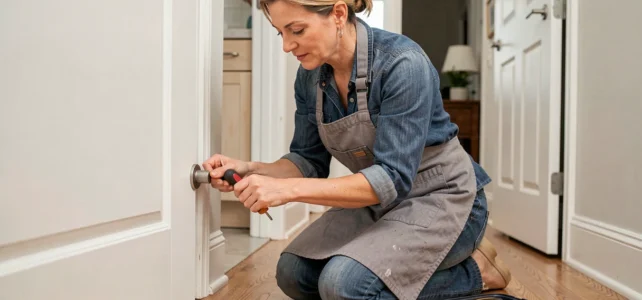
DIY at home encompasses a range of technical tasks from replacing a faucet washer to installing a wall shelf, including touch-up painting on a damaged wall. When mastered, these interventions can help avoid the systematic reliance on a professional and significantly reduce the maintenance budget of a home.
Regulatory limits of home DIY: what the law allows
Before getting started, it’s important to distinguish between what falls under free DIY and what requires professional intervention. The boundary is not always intuitive, especially in basic electrical work.
According to Élecineris (August 2026), individuals can replace a light bulb, test a differential with the T button, or clean around the electrical panel. Any intervention on a circuit, socket, or circuit breaker is outside the authorized scope and requires a qualified electrician.
This framework also applies to small DIY services at home under the personal services regime. According to Bricolage.fm, each intervention is limited to two hours in practice, and only basic, occasional, and low-risk tasks are covered. As soon as the estimated cost of a repair or maintenance service exceeds 150 euros including tax, a detailed quote becomes mandatory.
To progress in a structured manner, some DIYers choose to train through a practical training space with Bricoludik that offers targeted support on everyday tasks.

First DIY projects: which tasks to start with
The classic trap is to tackle an ambitious project (remodeling a bathroom, building a drywall partition) without having acquired the fundamental skills. Three categories of tasks offer a logical progression and visible results quickly.
Interior painting on a smooth wall
Applying wall paint is the quintessential entry-level project. The technique relies on preparing the surface: washing, filling cracks with acrylic putty, lightly sanding, and then applying a primer. The roller is applied in cross passes, without overloading. A standard-sized wall can be treated in half a day.
A well-prepared wall ensures a durable result without touch-ups. Neglecting sanding or skipping the primer leads to color differences and poor adhesion.
Wall fixtures and shelves
Drilling into a wall requires knowing the nature of the substrate (plaster, brick, concrete) to choose the right anchor. A stud or metal detector, available for a few euros, prevents drilling into a cable or pipe. A level remains the only reliable tool for correct alignment.
Minor plumbing: seals and faucets
Replacing a faucet washer or changing a shower hose only requires a wrench and Teflon tape. These interventions resolve most minor leaks and avoid calling a plumber for a job that takes less than twenty minutes.
DIY tools: building an effective toolkit without overloading
A common mistake is to buy a complete set of several dozen pieces, half of which will never be used. A progressive approach, project by project, is preferable.
The tools actually used in most home tasks can be counted on two hands:
- A cordless drill-driver, versatile for light drilling and screwing, covers most wall fixtures and wood assemblies
- A set of flat and Phillips screwdrivers, a five-meter tape measure, and a level form the basic trio for any measurement and adjustment
- A slip joint pliers, a utility knife, and a carpenter’s hammer complete the toolkit for light plumbing work and small assemblies
- Medium-grit sandpaper, acrylic putty, and masking tape cover the essentials of surface preparation before painting
Buying a good basic tool costs less than replacing three mediocre tools. For drill-drivers, the battery capacity (measured in amp-hours) determines the actual autonomy much more than the power displayed in watts.

Tax credit and fiscal ceiling for small DIY at home
Hiring a personal services provider for small DIY work entitles you to a tax advantage, but the framework is strict. According to Bricolage.fm, the “small DIY” category is capped at 500 euros of expenses per year per tax household for the tax credit.
This ceiling only covers eligible services: furniture assembly, curtain rod installation, light fixtures. Major renovation work or technical interventions (electricity, plumbing beyond replacing a washer) do not fall within this envelope.
Knowing this limit helps calibrate your choices. Delegating occasional tasks that exceed your skills while handling common projects yourself constitutes the best balance between savings and safety.
Materials and support: choose based on the project, not the price
The material budget often represents a modest part of the total cost of a project when a professional is involved (labor costs weigh more). When doing it yourself, this proportion reverses: the material becomes the main expense.
For paint, a quality one-coat formulation covers better and requires fewer passes than a budget paint applied in three coats. The final cost per square meter is comparable, but the working time decreases significantly.
For wood (shelves, small furniture), birch plywood offers a good compromise between lightness, strength, and ease of cutting. Medium-density fiberboard (MDF) is suitable for painted pieces but does not handle moisture well.
The quality of the substrate determines the longevity of the project. An appropriate material, even slightly more expensive, reduces rework and disappointments that discourage novice DIYers.
Gaining autonomy in daily life involves simple actions, repeated on projects within everyone’s reach. The regulatory framework sets clear limits that are best known before dismantling an electrical panel, and the fiscal ceiling of 500 euros per year for small DIY at home remains a useful reference for balancing between doing it yourself and delegating.