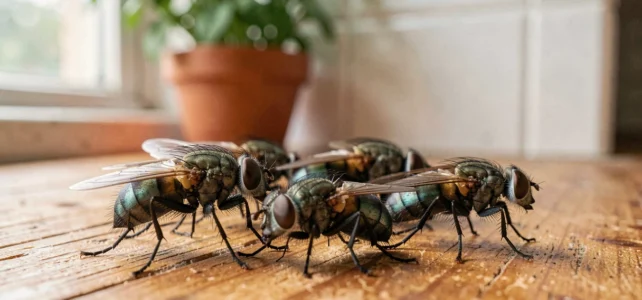
An invasion of flies in the house is not interpreted the same way depending on the species observed, the season, and the location of the individuals within the home. Before seeking any meaning behind this unusual presence, we recommend precisely identifying what is flying around your home, as the answer conditions everything else.
Identify the species to guide the diagnosis
The color, size, and flying behavior are enough to distinguish three radically different scenarios. Green or blue flies that appear suddenly point to decaying organic matter, often a dead animal stuck behind a wall, in the attic, or a chimney flue. These blowflies lay eggs within hours of the rodent or bird’s death, and the simultaneous emergence of dozens of adults gives the impression of a sudden invasion.
Increasing numbers of gray house flies (Musca domestica) rather indicate a breeding site linked to accessible organic waste: trash cans, food scraps, pet litter. Their reproduction cycle is rapid, with each female capable of laying several hundred eggs during her short lifespan.
The third case, often misinterpreted: large flies clustered on windows in autumn or winter. These are frequently attic flies (Pollenia rudis), which enter the attic at the end of summer to hibernate. They do not reproduce in the home. Their presence is not a health issue; it is a seasonal phenomenon related to insulation and entry points in the roof.

Hidden breeding site: locate the source when cleaning is not enough
If flies keep returning to the same spot despite a clean interior, the problem is not ordinary hygiene. We regularly observe invasions in perfectly maintained homes because the breeding site is located in an area inaccessible to daily cleaning. To better understand the meaning of a fly invasion, one must first examine these hidden areas.
Priority areas to inspect
- The kitchen or bathroom pipes and traps, where organic matter accumulates in the biofilm. Sewer flies (Psychodidae) lay eggs directly there.
- The crawl spaces, false ceilings, and wall cavities, which are prime locations for the decomposition of a small dead animal (mouse, bird that entered through a duct).
- The compost or outdoor trash can placed too close to a window or air intake, which act as a permanent reservoir for breeding near the home.
- Forgotten fruits or vegetables in a cupboard, cellar, or pantry, which particularly attract fruit flies and house flies.
The persistence of the invasion accompanied by visible maggots and a strong odor is the most reliable signal of an active breeding site. At this stage, a fly trap or adhesive paper only addresses the symptom.
Real health risks of a fly invasion in the house
House flies indiscriminately land on decaying matter and your food. They mechanically carry pathogenic bacteria (staphylococcus, streptococcus, salmonella) on their legs and bodies. The risk of food contamination increases proportionally with the number of individuals present in the kitchen.
A prolonged invasion in a space where meals are prepared poses a concrete health risk. This is not the case with a few isolated flies in summer, a common phenomenon that does not warrant any particular concern.
The line between a normal situation and a real problem is defined by three criteria:
- The number increases over several days instead of remaining stable or naturally decreasing.
- The flies concentrate in one room or on a specific area (a wall, a window, a ceiling corner), indicating a localized breeding site.
- Maggots appear on the floor, in a closed trash can, or near a pipe.
If these three indicators are present, we recommend searching for the source before multiplying insecticide products, which will not resolve anything as long as the breeding site remains active.
When to call a pest control professional
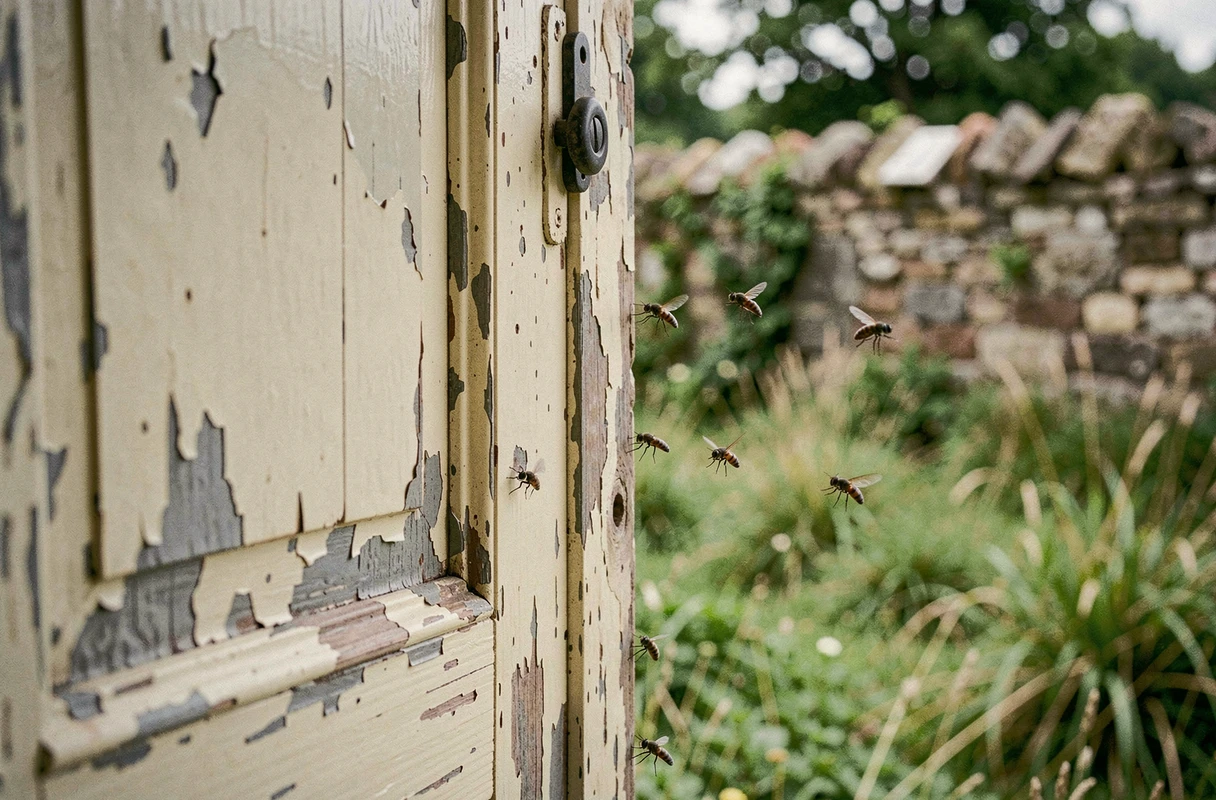
A treatment by a professional is justified in two specific situations. The first: you suspect a dead animal in an inaccessible area (persistent odor, numerous green or blue flies, located behind a wall or in an unvisited attic). Opening a wall without prior diagnosis is rarely relevant.
The second: the invasion recurs cyclically despite the elimination of all visible sources. This pattern suggests a permanent external breeding site, sometimes linked to a farm, manure storage, or a communal compost in the vicinity. A professional diagnosis can then identify the source and propose appropriate barrier measures (screens, treatment of entry points, targeted traps).
For the rest, most fly invasions are resolved by removing the breeding source and limiting access. Cleaning traps, covering trash cans, checking the sealing of windows and ventilation grilles is usually sufficient to reduce the population within a few days.
The presence of flies in a house has no hidden meaning. It has a material cause, almost always identifiable. Look for the odor, follow the concentration of insects, inspect the dead zones of the home. Once the breeding site is found, the problem disappears.