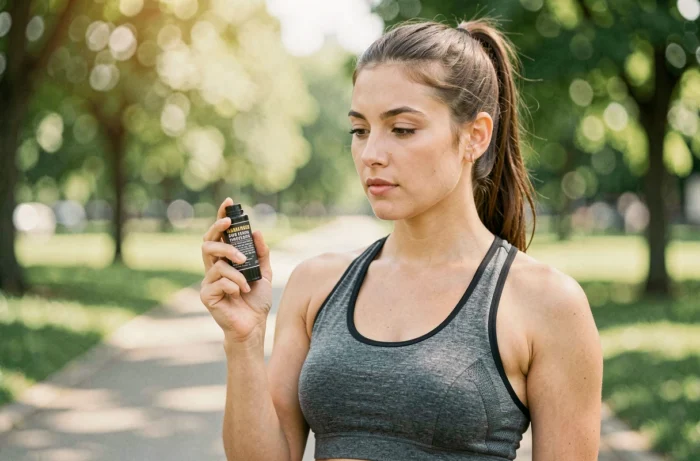
Decathlon does not sell tear gas or pepper spray. Searching for a self-defense pepper spray at Decathlon in-store or on the brand’s website invariably leads to a dead end. The explanation lies in the commercial positioning: defense aerosols fall under category D of the Internal Security Code, and their distribution is handled through armories, specialized shops, or websites dedicated to personal security.
Pepper gel or CS gas: the technical choice most guides overlook
We observe a recurring confusion between two families of active ingredients. The CS gas (orthochlorobenzylidene malonitrile) causes intense tear irritation but primarily affects the ocular and respiratory mucous membranes. OC pepper (oleoresin of capsicum) additionally triggers skin inflammation and swelling of the eyelids, which significantly impairs the assailant’s vision.
The diffusion technology is as important as the active ingredient. A pepper gel limits lateral dispersion and reduces the risk of the product returning to the user in unfavorable wind conditions. A cone spray covers a wider area, which may seem reassuring, but exposes nearby individuals and the user themselves more in confined spaces.
To better understand the differences between these devices, check out this analysis on the self-defense pepper spray at Decathlon. In an apartment or a narrow corridor, gel remains the most suitable format. Outdoors without wind, a classic spray may be justified if the projection distance is controlled.
Category D and legitimate reason: legal framework for defense aerosols
Defense aerosols with a capacity of 100 ml or less are classified as category D of the Internal Security Code. Their purchase and possession are free for any adult, without prior declaration or authorization.
The carrying and transportation outside the home follow a different logic. Articles R. 311-2, L. 315-1, and R. 315-1 of the Internal Security Code require a legitimate reason to carry a defense aerosol in public. The argument “for my defense” does not automatically constitute a legitimate reason: the assessment remains case by case, depending on the context and the discretion of law enforcement or the judge.
This legal nuance is rarely detailed in consumer guides. In practice, carrying a spray in a bag during a regular nighttime journey in an isolated area may be considered legitimate. The same spray carried during the day in a shopping mall raises more questions.
Real effectiveness of a pepper spray: limits that marketing does not mention
A defense aerosol is not a guarantee against an assault. We recommend considering three factors that significantly reduce the product’s effectiveness.
- Stress degrades fine motor skills. Removing the safety, aiming the spray, and maintaining sufficient distance under pressure require prior training, even minimal. A person discovering the mechanism at the moment of the assault loses crucial time.
- Some assailants under the influence of substances (alcohol, drugs) may exhibit increased pain tolerance. The incapacitating effect of OC pepper remains real, but the window of action may narrow.
- On an aggressive dog, OC pepper generally causes a retreat, but some highly motivated animals recover quickly or may be less sensitive depending on breed and level of excitement.
Wind remains the most underestimated environmental factor. A spray projected against the wind comes directly back to the user. Gel mitigates this risk without completely eliminating it.
Practical preparation: what distinguishes an effective carrier from a vulnerable one
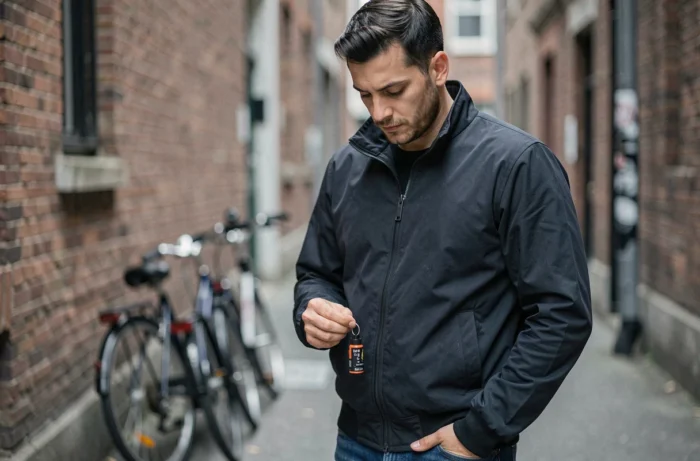
The location of the spray determines the reaction time. An aerosol stored at the bottom of a handbag is unusable in an emergency. We recommend an outer pocket accessible in less than two seconds, always the same, to create an automatic response.
Periodic mechanism check
Most pocket defense aerosols have a safety cap or a rotating lock. Regularly checking that this mechanism slides without resistance prevents unpleasant surprises. A spray whose safety jams under stress becomes a useless object.
Training without projection
Repeating the gesture of drawing, deactivating the safety, and pointing the spray at an imaginary target helps anchor the motor sequence. This type of training requires no projection and can be done at home.
Some manufacturers offer water training cartridges compatible with their models. This format allows practicing projection distance and spray accuracy without the risk of exposure.
Choosing a defense aerosol suitable for its use: concrete selection criteria
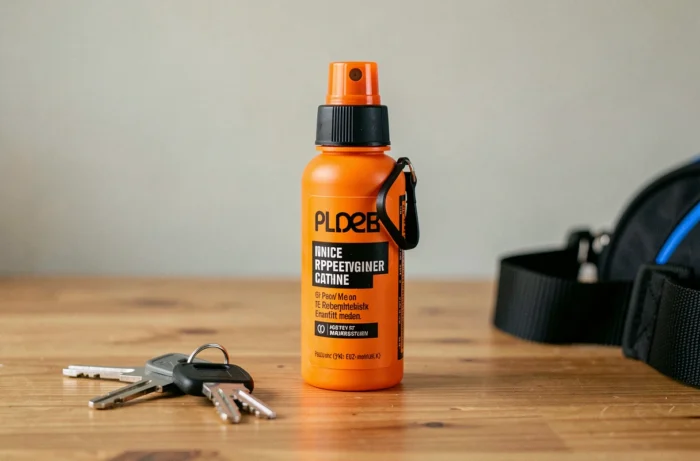
The volume of the cartridge determines the number of possible projections. Pocket formats, around 25 ml, provide a few seconds of continuous projection. This is sufficient for a one-time situation but leaves no margin for a second assailant or a missed first projection.
- For daily pocket use, a compact pepper gel remains the most relevant compromise between discretion, directionality, and limitation of cross-contamination.
- For sedentary use (home, business), a larger format with greater range offers more maneuvering room.
- For journeys in rural areas where there is a risk of dog encounters, a wide cone spray with a range of several meters better covers the situation than a directional gel that requires precise aiming at a moving animal.
The most expensive product is not necessarily the most suitable. The main criterion remains the consistency between the format, diffusion technology, and the actual context of use. A powerful spray that is too bulky to carry daily protects no one.
The expiration date also deserves attention. Active ingredients lose concentration over time, and the pressure of the propellant gas decreases. An expired aerosol projects less far, less forcefully, or not at all. Replacing your spray before the expiration date indicated on the container remains a basic precaution that many neglect.