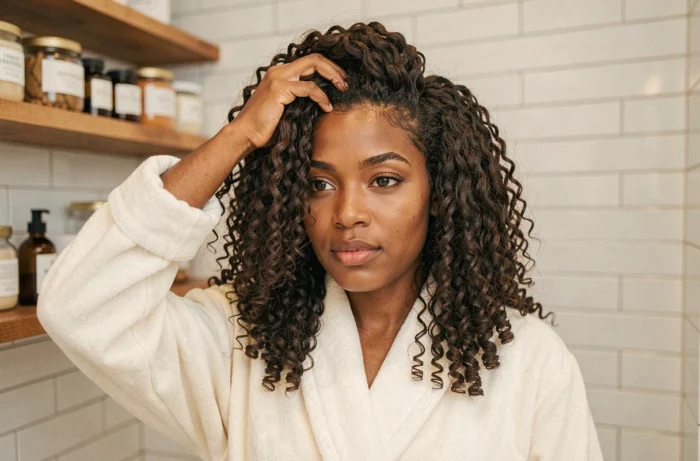
Curly hair grows at an average rate similar to other hair types. The visible difference lies in the length retention: the spiraled fiber, naturally dry, breaks before showing its true growth. Working on the growth of curly hair thus involves acting on two simultaneous fronts: stimulating the hair follicle and preserving every inch gained along the hair shaft.
Traction alopecia: the growth hindrance that treatments cannot correct
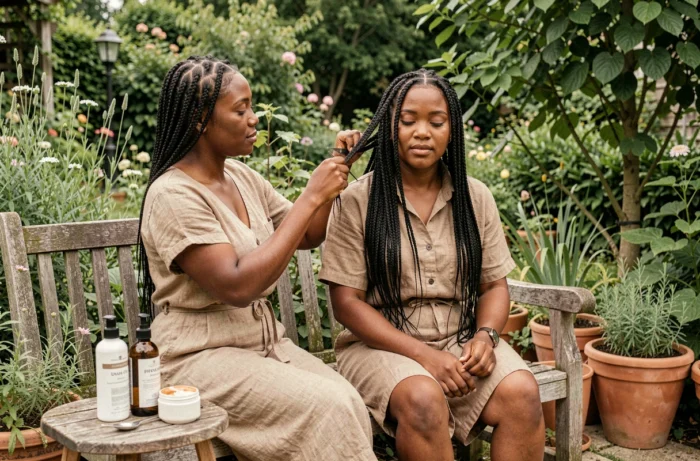
Content about hair growth often mentions protective hairstyles as a growth lever. In practice, many of these styles (tight braids, weaves, heavy extensions) exert a chronic tension on the follicle, especially at the temples and along the hairline.
This repeated tension is identified as the primary cause of density loss at the temples in women with curly hair. When the follicle is damaged by traction, no oil or mask can restart growth in the affected area.
Reducing mechanical tension is considered the priority action. Specifically, this means loosening braids as soon as they are installed, limiting the weight of extensions, and alternating the attachment areas from one hairstyle to another. To accelerate the growth of curly hair, reducing mechanical breakage yields faster results than any activating serum.

Vitamin D and hair follicle: an underestimated nutritional factor
Common recommendations regarding diet and hair growth emphasize iron, zinc, and protein. These nutrients play a real role, but recent research places vitamin D as the micronutrient most strongly associated with hair growth disorders, across all textures.
According to a synthesis published by Renaissance Clinique, the link between vitamin D deficiency and hair follicle dysfunction is well-documented enough to warrant systematic screening in individuals facing hair loss or slowed growth.
Before investing in expensive hair supplements, a blood test can check if a vitamin D deficiency is hindering growth. Supplementation, supervised by a healthcare professional, can then remove a blockage that external treatments cannot compensate for.
Moisturizing the curly fiber: suitable method and frequency
The spiral structure of curly hair prevents sebum from traveling down the shaft. The fiber remains dry on the lengths and ends, making it brittle. Regular hydration is the foundation of any length retention routine.
Water first, oils second
Hydrating does not mean applying oil to dry hair. Water remains the only real moisturizing agent. Oils and butters serve to seal in this hydration by forming a protective film around the hair shaft.
An effective method involves misting the hair with water or a water-based leave-in, then applying a vegetable oil (castor, avocado, jojoba) to the lengths. This sequence, repeated several times a week, maintains the fiber’s flexibility and limits breakage.
Washing frequency and choice of cleansing product
Washing too frequently with sulfate shampoos dries out the scalp and weakens the fiber. Spacing out washes and opting for a gentle cleansing product or a co-wash preserves the scalp’s hydrolipidic film without compromising cleanliness.
- Wash hair every seven to ten days with a sulfate-free shampoo or a cleansing conditioner
- Apply a deep moisturizing mask after each wash, leaving it on under a heating cap to open the cuticles
- Seal in moisture with a vegetable oil on still damp hair, focusing on the ends
Scalp massage and follicle stimulation
Massaging the scalp stimulates blood circulation around the hair follicle. This simple gesture, practiced for a few minutes each day with the fingertips (not the nails), promotes nutrient delivery to the hair root.
Adding a vegetable oil during the massage nourishes the scalp while reducing friction. Castor oil, dense and rich in ricinoleic acid, is the most commonly used in curly hair care routines for this purpose.
The massage does not replace a balanced diet or proper hydration, but it complements the routine by acting directly on the scalp, where growth begins.
Nocturnal protection and detangling: two gestures that preserve length
The cotton of pillowcases absorbs moisture and creates friction that breaks the ends during sleep. Sleeping with a satin bonnet or a satin pillowcase significantly reduces this friction.
Detangling deserves the same attention. On curly hair, detangling dry causes immediate breakage. The gentlest method is to detangle on wet, conditioned hair, using a wide-tooth comb or simply fingers, starting from the ends and gradually working up to the roots.
- Protect hair at night with satin (bonnet or pillowcase) to limit moisture loss and friction
- Detangle only on wet and conditioned hair, never dry
- Regularly trim split ends to prevent splits from traveling up the hair shaft
The growth of curly hair relies less on a miracle product than on the consistency of a routine adapted to the fiber’s fragility. Reducing mechanical tension, checking for a possible vitamin D deficiency, and maintaining regular hydration are three concrete approaches that, combined, help retain the length that the follicle produces each month.